
 0086-20-3156-0779


Advanced Equipment & Industrial Talent
Equipment Exports Hit a Five-Year High, and the Assembly Line Still Lacks Skilled Hands
On 16 November the State Council Information Office briefed on October's economic data, and equipment manufacturing again took the "ballast stone" slot: value added in the sector grew 10.2 percent year on year over the first ten months, its share of industrial output above designated size reached 37.9 percent, and export delivery value rose 12.5 percent, the fastest for the period in five years. Output numbers for nuclear power units, steam turbines, ships and industrial robots are all climbing in double digits, with nuclear generator sets nearly doubling. After years of strong data, the binding constraint has moved clearly onto the factory floor: who can assemble the equipment, commission it and deliver it on schedule. The answer runs through front-line technicians, process engineers and after-sales engineers, three job families whose gaps and pricing are being rewritten by the current boom.
Published by SunTzu China | Data as of: November 19, 2026
Sources: National Bureau of Statistics briefing on October economic performance, 16 November 2026 / state media readouts of the briefing / Ministry of Human Resources and Social Security public data on skills / cross-checked public postings and compensation research (anonymised)
Key Points
1. Equipment manufacturing grew 10.2 percent over the first ten months and now holds 37.9 percent of industrial output, contributing 3.7 points of growth. Export delivery value rose 12.5 percent, a five-year high, with 3D printer exports doubling in value.
2. High-end and green equipment leads: nuclear generator output up 96 percent, hydro turbine units up 35 percent, power-station steam turbines up 35.3 percent, civil steel ships up 39.6 percent, pulling demand for heavy assembly, precision welding and commissioning roles.
3. The gap sits in advanced technicians and hybrid process roles. Skilled workers hold roughly 30 percent of employment and the vacancy ratio for senior technicians has stayed above 2, while export growth pushes after-sales and overseas delivery engineers into a new shortfall with sharply tiered pay.
Start with the data. Value added in equipment manufacturing above designated size grew 10.2 percent over the first ten months, flat against the first three quarters, pulling overall industrial growth by 3.7 percentage points, close to forty percent of the sector's total increment. The share tells the longer story: equipment manufacturing's weight within industrial output rose 3.1 percentage points across the previous five-year plan and another 1.8 points this year, reaching 37.9 percent. In plain terms, nearly four of every ten yuan of industrial value added now comes from equipment, and the centre of gravity of Chinese industry has shifted toward its mid-to-high end.
The statistician summarised the year in three traits: sustained double-digit growth; standout performance by high-end, smart and green equipment; and rising quality and volume in exports. The export trait carries the sharpest number. Export delivery value for the sector rose 12.5 percent over the first ten months, the fastest for the period in five years, and equipment manufacturing now accounts for more than three quarters of the export delivery value of all industry above designated size. The export basket of Chinese manufacturing is now dominated by machinery, by equipment.
The World Intellectual Property Organization's 2026 Global Innovation Index adds corroboration: China has ranked among the ten most innovative economies for a second consecutive year, with twenty-five of its innovation clusters in the global top one hundred, the largest count worldwide for a fourth straight year. Most of those clusters are precisely the equipment manufacturing bases, the clusters around complete power-generation sets, shipbuilding, robotics and additive manufacturing. Output and innovation confirm each other, and the boom has industrial depth beneath it.
The output numbers deserve a closer read. Over the first ten months, nuclear generator output rose 96 percent, hydro turbine units 35 percent, and power-station steam turbines 35.3 percent, the three main families of power-generation equipment ramping together on the back of nuclear construction, hydro refurbishment and thermal flexibility retrofits. Civil steel ship output rose 39.6 percent against a delivery window shaped by globally high order books. On the smart side, 3D printing equipment output rose 64.6 percent and industrial robots 32.3 percent, two lines that are themselves production equipment for other industries, the machine-building-machine loop already turning.
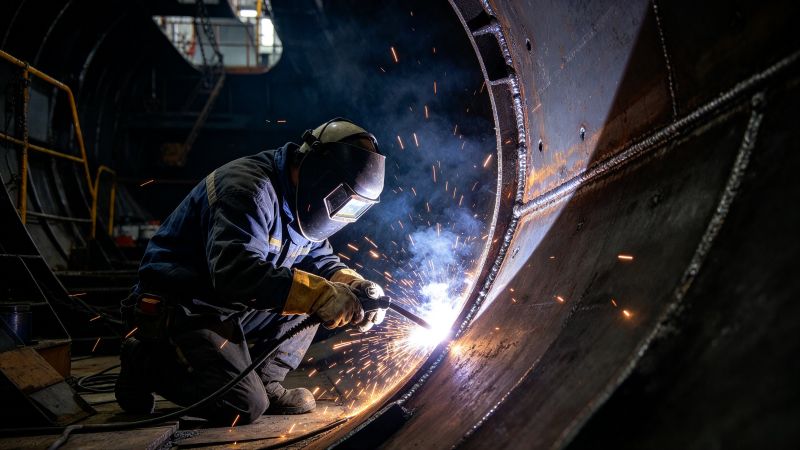
Rising output also raises manufacturing difficulty. Nuclear-grade welds follow nuclear inspection standards, large castings and forgings carry traceability from melt to ultrasonic test, and core components for a gigawatt-class unit take months to pass acceptance. Shipyards need senior welders certified by classification societies and by the target shipowner simultaneously; steam turbine blade machining demands complete command of five-axis setup and adjustment. What these stages share is dependence on people. Machines can be bought, tooling can be imported, but the craft of holding tolerances and weld quality inside standard can only be built by experienced technicians over years.
Hiring demand moves with the production schedule. Around the power-equipment and shipbuilding bases, postings for fitters, hull assemblers, welders and CNC setter-operators have stayed at high levels all year, and some bases now show an "orders waiting for people" pattern: interview cycles compressed to a week, skilled hires on the line within the month. Compensation research shows nuclear-grade welders commonly clearing RMB 10,000 a month, with shipyard welders holding classification certificates and five-axis setter-operators earning thirty percent or more above ordinary technicians.
The export numbers carry their own job content. Over the first ten months, 3D printer export value grew 104.8 percent, ship exports 22.4 percent and industrial robot exports 17.8 percent. Equipment exports follow a delivery logic that consumer goods never touch: a machine arriving overseas still needs installation, commissioning, acceptance, operator training and spare parts supply, and each stage needs staff. After-sales service engineers, overseas installation and commissioning engineers, and resident technical support are the fixed configuration of equipment exports, and every step up in export growth sends another wave of hiring into these roles.
The requirements have broadened. Beyond mechanical and electrical fundamentals, overseas delivery roles now require reading English drawings and specifications, direct communication with the client's engineering team, and independent completion of acceptance documentation; roles aimed at Europe and the Middle East add knowledge of local safety codes and acceptance standards. The combination of technology, language and compliance is naturally scarce. For employers, search cycles run twice as long as domestic technical hires, and overseas allowances, rotation design and career paths become retention variables in their own right.
A quieter transmission matters too: export quality gates raise the domestic quality function. Overseas owner supervision and third-party inspection standards usually exceed domestic project norms, so demand rises for NDT inspectors, third-party inspection staff and quality system engineers as export share climbs. Quality has moved from cost centre to a delivery-critical node, and its pricing is being recalibrated accordingly.
Zoom out for the gap. Ministry data show about 220 million skilled workers in China, roughly thirty percent of employment, with highly skilled workers about thirty percent of that skilled pool. In the labour market, the job-seeking ratio for senior technicians has long stayed above 2, two jobs chasing one person. Double-digit growth in equipment manufacturing keeps enlarging the denominator while the numerator crawls, so the gap widens with every ramp-up.
The structure of the gap matters more than the size. First, an age cliff: a large share of senior technicians inside equipment firms are past fifty, and replacing them takes five to eight years of formation, faster than retirement. Second, a mismatch: vocational colleges supply plenty of graduates, but employers report long onboarding curves in drawing literacy, tolerance fitting and process understanding, all requiring in-house retraining. Third, new skills stacking the old: five-axis machining, robot integration, additive manufacturing and smart-line maintenance are roles whose training systems are still chasing the industry.
Policy is filling in behind. The eight-grade skill ladder ties grade progression to pay, industry-education integration and new apprenticeship schemes expand every year, and local governments subsidise training in shortage trades. Companies that use the toolkit well lower the cost of their own academies, but formation has a cycle, and the current delivery gap still resolves through market mobility, which is why search demand in the equipment sector stays at the top of the hiring market.
The table places the main roles downstream of the boom in one view. Pay figures come from cross-checked public postings and compensation research, anonymised by convention, with bands reflecting major industrial bases nationwide and premiums in tier-one cities and leading firms.
| Role | Core requirements | Supply state | Pay band reference |
|---|---|---|---|
| Fitter / assembly-setter technician | Heavy-part assembly, clearance control, drawing and process discipline | Experienced hands scarce; hiring cycles compressed | RMB 7,000-15,000 per month, premiums at nuclear and ship bases |
| Nuclear-grade / class-certified welder | Nuclear or classification certification, first-pass weld quality | Certified welders short; long certification cycle is the gate | Compensation research shows RMB 10,000+ per month, 30%+ above ordinary welders |
| Five-axis CNC setter-operator | Complex-surface machining, tool and program tuning, accuracy upkeep | Blade and precision capacity expansion keeps demand ahead | RMB 10,000-20,000 per month; mentor-level setters reach RMB 250,000+ annual packages |
| Process engineer (equipment assembly) | Process routing, assembly schemes, line takt optimisation | Demand concentrated in ramp-up phases, cross-industry flow rising | RMB 12,000-25,000 per month plus project bonuses |
| Overseas commissioning / after-sales engineer | Site installation, acceptance documents, training, spares support | Export growth drives demand; hybrid profiles scarce | RMB 15,000-30,000 per month plus overseas allowances and rotation leave |
The five rows share a trait: pay rests on craft and experience, filtered by certification and project history. Compared with office-track roles, the curve is steeper, with the distance from ordinary technician to senior technician stretching beyond a factor of two, and the premium grows closer to the delivery front line. For young jobseekers, the equipment shop floor has become a path worth walking again; for employers, pricing power has shifted toward the scarce-skill side, and employer brand plus training system now matter more than headline pay.
First line: align production scheduling with workforce planning. Delivery schedules roll monthly, hiring plans move quarterly, and the mismatch shows up as staffing gaps exactly at delivery peaks. Convert the next two quarters of production plans into hour requirements by trade, run a gap calculation against headcount and skills structure, and start searches three months early wherever the gap exceeds ten percent. Certification-gated roles, nuclear welders and certified inspectors above all, need an even longer lead.
Second line: make the training system a retention tool. New apprenticeships, sponsored classes, in-house grade certification and skill-linked pay agreements form a complete policy toolbox; the task is to chain them into a visible path from entry to senior technician with clear pay steps and certification gates. Compensation research shows firms with a complete path running technician turnover five to ten points below the local average, which makes the training spend pay back quickly.
Third line: accept market mobility for the urgent gap. The fastest-moving vacancies cannot wait for formation, so hiring from peers and adjacent industries is the practical route. Power equipment, shipbuilding, machine tools and robotics share highly transferable process and commissioning talent, and cross-sector searches convert better than single-target poaching. For overseas delivery roles, screen first among candidates already rotated through Southeast Asian or Middle Eastern projects, where language and site experience verify cheapest. In a boom cycle, the firms with a stable talent pipeline turn hiring into delivery capability.
A reminder for HR: the boom will run, but certification cycles are hard constraints. Nuclear-grade welders, classification certificates and five-axis setters cannot be formed in months. The hiring window opens before the production plan is confirmed, not after the equipment arrives.
Return to the briefing numbers: a 37.9 percent share, export delivery value at a five-year high, nuclear output nearly doubled. Behind every number stands a line running overtime and an order awaiting acceptance, and every delivery ends in the hands of a qualified technician. The stage is built; the talent supply, the harder act, is just getting under way.
A: Order books and delivery cycles point that way. Mid-to-high-end equipment runs on multi-year delivery schedules, and projects now under construction in nuclear, shipbuilding and power generation set the output floor for the next two to three years. Monthly data will fluctuate, but the rising share and the upgrading export structure support sustained hiring demand. For jobseekers, technician roles offer notably higher employment certainty than most sectors.
A: Yes, with the right entry. Candidates with mechanical, electrical or welding foundations convert fastest. Those starting fresh should enter through new apprenticeship or sponsored-class programmes, which carry training subsidies and a defined path, with better odds than cold applications. After-sales and inspection tracks are more degree-flexible and serve as common cross-industry entry points.
A: Supply and demand say yes. The job-seeking ratio above 2, certification-based replacement costs and the eight-grade pay-linkage policy all give employers grounds to raise wages in steps. Each grade jump commonly carries a fifteen percent or larger pay step, and technicians who can mentor or solve hard site problems keep gaining bargaining power.
A: Depends on the life stage. Total income usually runs thirty to fifty percent above equivalent domestic roles once overseas allowances are counted, and delivery history abroad is highly valued inside the equipment industry. Weigh rotation rhythm and family arrangements; get rotation cycles, leave policy and the post-assignment role written into the contract before signing, which matters more than the monthly figure alone.
A: In most cases, yes. Apprenticeship subsidies, in-house certification after filing, and skill-linked pay reduce net cost and normal wage pressure; government support, productive output during training and lower attrition offset the rest. Use market search to cover the current gap and build the academy for long-term supply; running both tracks is the sensible configuration for equipment manufacturers.
SunTzu China
SunTzu China works with power equipment, shipbuilding, machine tool and robotics manufacturers on hiring across assembly, welding, CNC, process and overseas delivery families, and supports the design of technician development paths and the search for key technical and management staff. If ramp-up is straining your workforce plan, we are glad to help.
More analysis on advanced equipment and China's hiring market is available at www.suntzuchina.com, or contact us directly for executive search support.




 Fab Equipment Engineering Directors in China: Who Can Own Uptime